
Planning to Maximise your QOF Potential in Q4 using SystmOne
Introduction
This is the first in a series of guides to help practices use PCIT resources to maximise potential QOF income in Q4 by understanding their outstanding workload, breaking it down and working through it efficiently and effectively.
The first stage is to make a clear plan for the quarter. For this you will usually want to:
1. Identify your missing income
2. Identify what work is needed for each indicator
3. Decide on your practice priorities
4. Create an action plan for tackling these priorities
1. Identify your missing income
We recommend monitoring this throughout the fiscal year but especially in Q4 as it will usually be a key element in determining your practice priorities for QOF work.
You will need to identify the following:
a. Overall potential missing income
b. Potential missing income per indicator
c. Number of patients needed to achieve max income per indicator
d. Value per patient for completing the work for that indicator
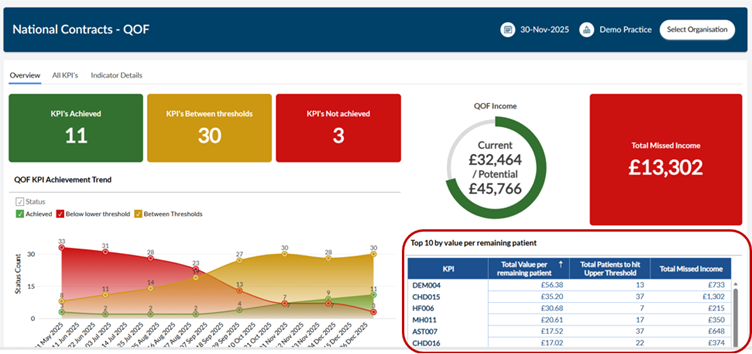
If you have PCIT’s OneAnalytics Tool these figures are clearly identified in the QOF dashboard. The Overview page includes a view of the top 10 indicators by value per remaining patient. We can see here that DEM004 will not have the most potential missed income overall but the practice only needs to review 13 more patients to achieve that income and those reviews are work approx. £56 each.
The KPIs page will then allow you to review your QOF indicators and order that information in different ways. Here we can see that HYP008 is worth the most in potential missed income overall. But we can also see that 411 patients are needed to achieve that income.

It is important to note that these are approximate figures based on monthly extracts and available national data in relation to prevalence. Reducing the overall size of the demographic population by sending 2 invites or adding other PCAs changes the percentage achievement and the number needed to hit that target.
If you do not have the OneAnalytics Tool or which to recalculate figures during the month, you can use our searches to calculate this information.
Please see our support article with all the details on where to find the information you need and how to calculate the figures.
2. Identify Work Needed for Each Indicator
The practice should now have a list of outstanding indicators and an approx. missing income calculation for each as well as number of patients needed to achieve the target.
Work needed for QOF indicators will tend to fall into one of the following:
· Appointment with clinician
· Clinical review of the notes
· Administrative review of the notes including coding of responses from patients
At the beginning of Q4 practices will usually want to prioritise work that needs a clinical appointment as these patients will need to be scheduled into busy clinics. For any indicators where a clinical appointment is needed, the practice should look at which members of staff will be taking these appointments, number of appointments needed to achieve the target and length of appointment needed. This will enable you to calculate the amount of staff time needed to achieve the target and look at the potential income per appointment to see which of these indicators should be prioritised.
For practices who review patients in their birthday month including those who use the OneRecall system for this, we recommend sending invites for patients due in February and March a little earlier than other months.
Work requiring a clinical review of the notes but no appointment will need to be planned out according to the time involved per patient and the number of patients to be reviewed. This may include work such as reviewing patients who have previously been coded with PCAs such as not clinically appropriate, medication related indicators and those which involve patients achieving a test result value within a specific range.
Administrative review or administrative work. This includes the admin work involved in running searches and providing information to GPs or sending out invites to patients, sending out questionnaires to patients and coding replies, running data quality searches and liaising with clinicians about coding.
The practice will need to decide which of the outstanding indicators will fall into which category of work and which staff would be needed to complete that work.
3. Decide Practice Priorities
It is important to prioritise the workload and ensure the team all know what the practice wants to prioritise. This helps to ensure people are looking out for proactive ad-hoc coding when patients are in the practice for other reasons.
Priorities should consider clinical implications, practice workload, staff availability, potential overall income for an indicator and potential income per patient added for the indicator.
Use the OneAnalytics Tool or PCIT 004A searches to identify the number of patients needed to achieve maximum income per indicator.
4. Create an Action Plan
Practice action plans will vary depending on the practice position at the beginning of Q4, the work needed and the agreed priorities.
An action plan will usually identify the key indicators that the practice as a whole is prioritising for the rest of the QOF year. This may also be done on a month by month basis.
Consider
· What needs to be achieved
· Who will be doing the work
· When that work will be done
· How the whole team will work together to achieve the target
Remember the PDSA cycle – Plan, Do, Study, Act
Creating a plan is just the beginning, practices aiming to achieve full points will need to review progress and update the plan as the situation changes during the quarter.
Conclusion
This is the first in our series of regular articles which will offer Q4 tips for achieving maximum QOF points in a number of different areas using PCIT’s suite of resources.
Don’t forget to look out for next week’s article “Using PCIT searches to maximise QOF potential in Q4”.